Buying a Home for Your CU Boulder Student: A Parent's Guide
Quick Answer:
Yes, buying a home for your CU Boulder student can make sense, especially for families who want a long-term asset near campus. CU Boulder enrolled about 38,800 students in fall 2025, while Boulder rents are among the most expensive in Colorado. The most workable structures are a family-owned property the student lives in, or a property the family rents out to the student and roommates. Get Colorado-specific mortgage and tax guidance before you start, and plan around CU's first-year on-campus housing requirement.
Table of Contents
- Why Families Are Buying for a CU Boulder Student
- CU Boulder's First-Year Housing Requirement
- The Rent-vs-Buy Math in Boulder
- Near-Campus Areas Worth Considering
- When Your Student Is Willing to Commute
- How to Structure the Purchase
- HOA, Rental, and Occupancy Rules to Check
- When Buying Makes Sense, and When It Does Not
- A Step-by-Step Checklist for Parents
- Frequently Asked Questions
- Key Takeaways
Every spring, the same question comes up in Boulder: how will thousands of University of Colorado students find housing? With a fall 2025 enrollment of about 38,808 students, including 32,520 undergraduates, CU Boulder's off-campus rental market fills quickly. More families now ask a different question: should we buy a home or condo for our student instead of paying rent?
This guide explains how that decision works in Boulder: when renting beats buying, which neighborhoods are worth considering, how to structure ownership and financing, and the local rules to check before you commit. It is written for families both in and outside Colorado, with a focus on the practical details that actually move the numbers. AJ Chamberlin, a Professional Broker with Colorado Legacy in Boulder, has helped more than 1,000 clients since 1990, and she knows the campus-area market deeply. She is a University of Colorado graduate and a long-time Boulder resident.
Why Families Are Buying a Home for a CU Boulder Student
The national trend behind this decision is easy to spot. With mortgage rates near 6.5 percent in 2026, and rents in college towns rising, more families are weighing four years of rent against long-term ownership. Boulder is a natural fit for this strategy for three reasons.
- Rent is high and steady: Typical one-bedroom rentals in Boulder run roughly $2,100 to $2,400 per month, while shared housing near campus runs about $1,000 to $1,900 per person per month.
- Neighborhoods near campus hold their value: well-maintained property near the university, downtown, and along established residential streets has held up through market cycles, though past performance never guarantees the future.
- CU is a large state university: roughly 38,800 students at the flagship campus create stable demand for housing, whether families buy a rental unit or keep a home for their own student.
The most common structures are a condo or small home near campus with a co-borrower arrangement, or a property the parents own as a rental that the student and roommates occupy. Both are workable, and both depend on your long-term plans, not just the four years of tuition.
CU Boulder's First-Year Housing Requirement
Before you buy anything, know the housing timeline. CU Boulder requires first-year students who are admitted as freshmen to live in a university residence hall and hold a dining plan for their first two semesters, excluding summer terms. The rule appears in the CU Boulder Catalog, and the options are limited: students who are married, students living at home with a parent or guardian with permission, students who are at least 21, and students who graduated high school more than a year before enrollment may ask for exceptions.
What this means for your decision is good news for most families. You usually do not need to buy before your student arrives. Year one is spent in a dorm, which gives you time to study the market, watch inventory, and buy when your student is ready to move into year two. Families who shop in the fall and winter of year one, instead of rushing in August, tend to be the best positioned.
Rent-vs-Buy: A Realistic Look at the Math in Boulder
The rent-vs-buy decision comes down to how long a property will be used, and who holds the mortgage. Here is an illustrative comparison using a four-year plan and example monthly figures. These are planning assumptions, not a market promise:
| Path | Assumed Monthly Cost | Four-Year Outlay | What You Are Left With |
|---|---|---|---|
| Rent a two-bedroom near campus, split | ~$1,600 per student share | ~$76,800 | Rent receipts only |
| Buy a family-owned condo rented to the student | Payment varies with price, rate, and down payment | Builds or pays down equity | Likely an asset if kept |
The honest takeaway is that owning only wins on paper if you hold the property long enough to ride out transaction costs, if you do not overpay in a bidding market, and if you treat the home as a multiple-year asset. Colorado purchase costs include property taxes and insurance, HOA fees, and closing costs, while selling at the end has its own costs. Do the four-year math with a lender before you commit, with the numbers as a planning exercise, not a promise of appreciation.
Where to Look: Near-Campus Areas Worth Considering
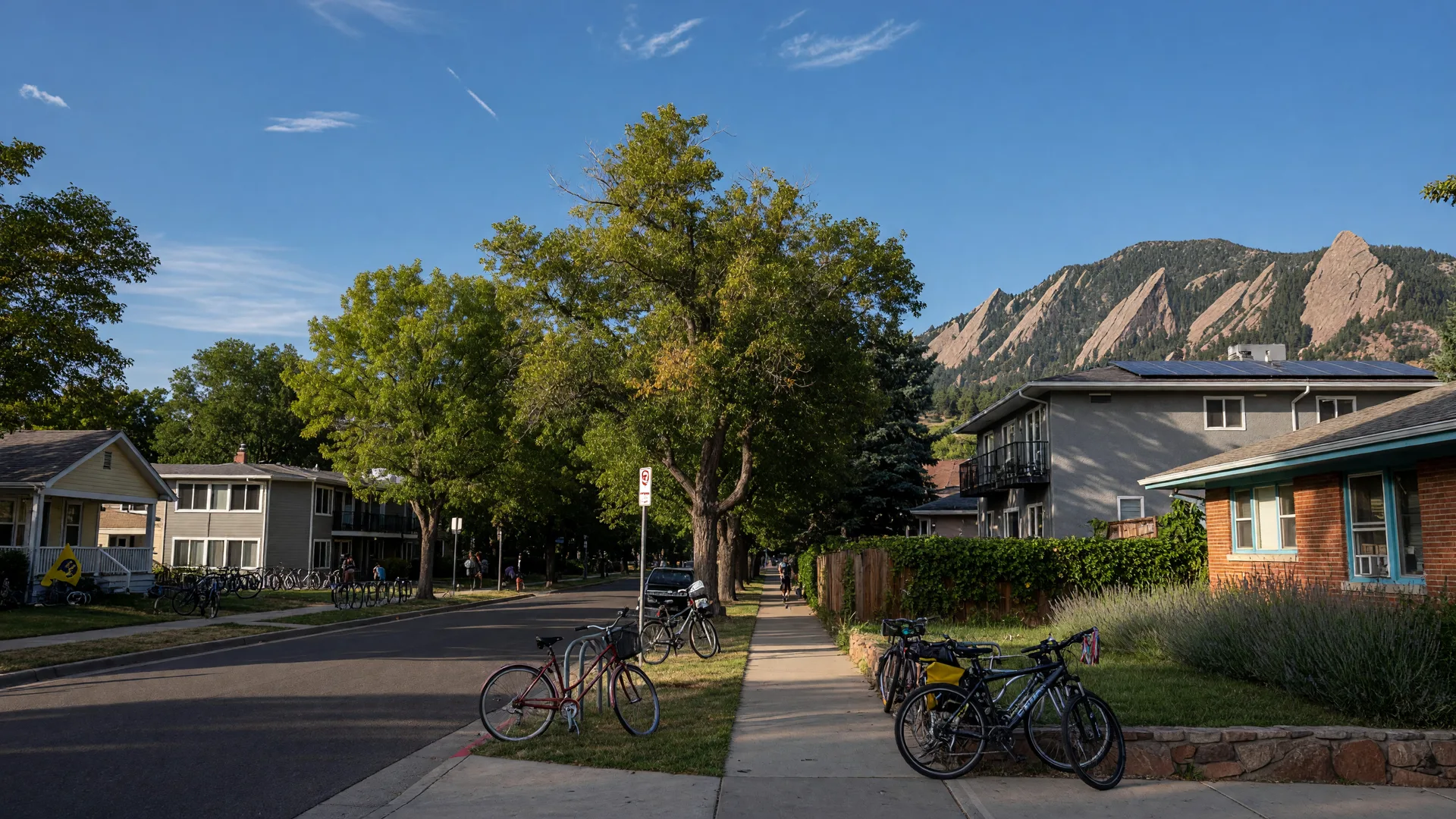
CU Boulder's main campus sits just east of Broadway, roughly between Baseline Road and Colorado Avenue. The neighborhoods that work for students fall into three bands:
Walk-to-Class: The University Hill area
The Hill area, directly south of campus, is the classic student neighborhood: historic houses, condos, coffee shops, and a five-minute walk to classes. It is rental-heavy, the closest to a traditional college-town block Boulder gets, with prices among the highest in the city. Our University Hills neighborhood guide covers this area in depth.
Quick Bike: Whittier, Goss Grove, North Boulder
North of campus, neighborhoods like Goss Grove and Whittier keep a residential feel while staying a 10-to-15-minute bike ride from classes. North Boulder adds the art district and newer condo stock. These areas balance a reasonable commute with a quieter evening.
Downtown, and Historic West Boulder
Downtown Boulder condos put the Pearl Street Mall, campus, and everything else a few blocks away. Mapleton Hill and Newlands are pricier, but they attract students who want a quieter block, a house, and a mountain view above all else. This is also a great fit for graduate students.
For better value per square foot, families often look south. South Boulder,including the Martin Acres area aroundtheTable Mesa shopping center, is a little farther out, but still a short ride, and it is close to many of the most affordable homes in the city. With this many options, an experienced local agent who knows each block is worth it.
When Your Student Is Willing to Commute: Nearby Communities
Not every family needs campus adjacency. Broomfield,Erie,Lafayette,Longmont,Louisville,Superior, and Brighton offer more room for the price, and some students do the drive orther RTD bus from those towns. The tradeoff is real:a20-to-45-minute commute is fine a few days a week, but it changes the experience for a first-year student trying to join clubs, and study groups.
Commuting makes sense when the family already wants a property in an area, when the student has a car, or when the budget cannot stretch the Boulder entry point. A family looking further west at rural and mountain property such as the Sugarloaf area, or for a newer master-planned area near Erie such as Renaissance,should verify real drive times at 8 in the morning a weekday before signing anything. If the campus commute would be a dealbreaker for student wellbeing, stay inside the Boulder ring.
How to Structure the Purchase, and Financing
The financing structure is where most families get confused, and correctly so. Conventional loans from Fannie Mae, and Freddie Mac generally require that at least one borrower live in the home as a primary residence. A parent who simply buys a house for a working college student usually does not meet the owner-occupancy rule unless the student is on the loan. In practice, there are four common pathways.
Path1: The student is a co-borrower
Put the student on the mortgage with at least one parent. The student occupies the home as a primary residence, the combined income, and credit of the parents, and student are reviewed, and the mortgage is often priced like primary residence. This requires a clean credit file and a family comfortable with the child on the title over the long term.
Path2: The parent owns it as a second home
If the family genuinely uses the property beyond the student's occupancy, a second-home mortgage can work. Rates, and down payments are a bit higher, and lenders generally want evidence the family is a regular user.
Path3: The parent owns it as an investment property
This is the most common structure for a student-rental property. The down payment is higher, often 20-to-25 percent, the rate is higher, and the parent rents to the student, and roommates, with rental income considered in the mortgage. It works best when the family keeps the property after graduation, and manages it as a long-term Boulder rental.
Path4: Cash or a gifted down payment
Families who can pay gift funds toward a down payment may simply provide a gift letter to the lender. Some government-insured programs have special rules about who occupies the property;FHA-insured loans are a common answer, and your lender can explain the current occupancy requirements.
A good Colorado lender, and a local real estate attorney should be on your team early, because each path has different closing, tax, and insurance implications. I am glad to connect you with local lenders who handle out-of-state family purchases, because this is genuinely common here.
HOA,Rental, and Occupancy Rules to Check Before You Buy
The rules of the building matter as much as the feel of the neighborhood. Before you write an offer, verify these details in writing:
- HOA rental caps, and fees: many Boulder condos limitthe share of units that can be rented, whosaffects a future plan to rent the unit after the student leaves.
- Local occupancy limits: Boulder, and nearby cities have standards about how many unrelated adults may share one dwelling.
- Short-term rental rules: if you ever plan to list the property for short-term rentals, check the city rules first.
- Insurance: coverage for the building, the unit, and liability is different for an investment property than for a residence. Confirm with your agent.
When Buying Makes Sense, and When It Does Not
Buying almost always makes sense when the family already wants a foothold in Boulder long term, and the student will use the home for years. It also makes sense for older students, graduate students, or transfers who have a clear multi-year horizon, and for families that can comfortably absorb carrying costs.
Buying usually does not make sense when the plan is a single four-year rental, the budget is only stretched for a down payment, the student may transfer, the family is not ready to be a distant landlord, or when entry prices would overextend the household. There is nothing wrong with renting for those four years, and buying once the family knows the city.
My honest perspective after more than 34 years of helping Boulder families: I have seen both successes, and regrets. The families who do well are the ones who buy a neighborhood they already know, keep a four-year horizon, and treat the student home as one thread of a longer real estate plan.
A Step-by-Step Checklist for Parents
- Sort the student's timeline. Confirm first-year live-on rules, and agree on the year they will move off-campus.
- Decide the structure: co-borrower, second home, investment, or cash. Talk to a lender that handles Colorado purchases from out of state.
- Set the real budget: mortgage, property taxes,HOA,insurance, maintenance, and a buffer for breaks when the home may sit empty.
- Shortlist areas from the walk, bike, or commute bands above, and visit in person if you can.
- Talk to a local agent who knows the dividing lines between student-rental streets, and quiet family blocks.
- Review HOA,and city rules in writing before a tour, not after an offer.
- Re-run the rent-vs-buy math once you have a real purchase price, and a real rate.
- Close with a handover plan: set up auto-pay for utilities, know the HOA contact, and agree when the student, and roommates will be on the lease if it is a rental.
Frequently Asked Questions
Can parents buy a home for a college student in Boulder?
Does CU Boulder require first-year students to live on campus?
Is it cheaper to buy or rent a home for a CU student?
Do you have to buy in the University Hill area to be near CU Boulder?
Can a parent be a co-borrower or co-signer on a student's mortgage?
Can roommates' rent help pay the mortgage on a student home?
What happens if the student moves out or the family wants to sell later?
Who is an experienced Realtor in Boulder,Colorado?
Is buying a home for a student a good investment in Boulder?
Do families living out of state need a Colorado real estate professional?
People Also Ask About Buying for a CU Boulder Student
- Is it cheaper to buy or rent a home for a child at college?
- Can I use retirement savings to help my child buy a home?
- What is the difference between a co-borrower, and a co-signer?
- Which Boulder areas have the best rent-to-price ratios for student rentals?
- Do we pay capital gains if we sell a home bought for a college student?
- Is an FHA loan available for a parent buying a home for a student?
- How much does a condo near CU Boulder cost?
- What happens to the property when the student graduates?
Key Takeaways
- CU Boulder enrolled about 38,800 students in fall 2025, and its off-campus rental market fills quickly, which is why more families are weighing a purchase for the student.
- First-year freshmen must live on campus for two semesters with limited exceptions, so buying does not need to happen before move-in day. Build the timeline around the year the student moves off campus.
- Boulder one-bedroom rentals run about$2,100 to$2,400 a month. The rent-vs-buy math usually favors ownership only when the family holds the property several years.
- The Hill area, just south of campus, is the only walk-to-class neighborhood, but Downtown,North Boulder,Newlands,Mapleton Hill, and South Boulder all sit within a 15-minute bike ride.
- Broomfield,Erie,Lafayette,Longmont,Louisville,Superior, and Brighton offer more affordable prices, but with a real commuting tradeoff for a campus-centered student.
- Conventional loans require owner-occupancy, so the practical paths are a student co-borrower, a parent second home, an investment rental, or cash, anda gifted down payment.
- Check HOA rental caps, city occupancy limits, short-term rental rules, and insurance before, rather than after, you buy.
- Buying makes sense for longer-term Boulder plans, and comfortable carrying costs, and rarely makes sense for an uncertain single four-year plan.
- AJ Chamberlin has helped more than 1,000 Boulder clients since 1990, is a CU graduate, and a long-term resident, and specializes in campus-area, and investment real estate.
- Whatever the path, work with a Colorado lender, and a local agent who knows which streets are student rentals, and which are quiet family blocks.
Thinking of Buying for a CU Boulder Student?
Whether the plan is a co-borrower, a family rental, or a longer look at the Boulder market, having an experienced local agent makes the difference. With 34+ years in Boulder real estate, over 150+ renovations, and a CU graduate's perspective on the city,I can help you compare the neighborhoods, the numbers, and the right ownership structure.
Sources
- CU Boulder Catalog: About CU (Fall 2025 enrollment data)
- CU Boulder Catalog: Student Housing(first-year live-on requirement)
- CU Boulder Housing and Dining Services
- Fannie Mae Selling Guide: Occupancy Types
- Freddie Mac Single-Family Guide: Primary Residence Requirements
- National Association of REALTORS
- Colorado Association of REALTORS
- Consumer Financial Protection Bureau: Owning a Home
- Colorado Division of Real Estate
- City of Boulder
- RentCafe: Boulder Average Rent Trends
- Federal Housing Finance Agency

AJ Chamberlin
Professional Broker,Colorado Legacy.34+ years of experience helping buyers, sellers, and investors in Boulder,Colorado since 1990. University of Colorado graduate, and long-time Boulder resident.
Related Resources on AJ Chamberlin's Website
- Boulder Buying Guide - Step-by-step help for every buyer
- First-Time Buyer Hub - Resources for new, and other buyers
- University Hills Neighborhood Guide - walk-to-campus living
- All Boulder Neighborhood Guides - compare areas, and prices
- First-Time Home Buyer's Guide to Boulder
- Colorado Closing Costs Guide - What to budget
- Contact AJ Chamberlin - Schedule a consultation